

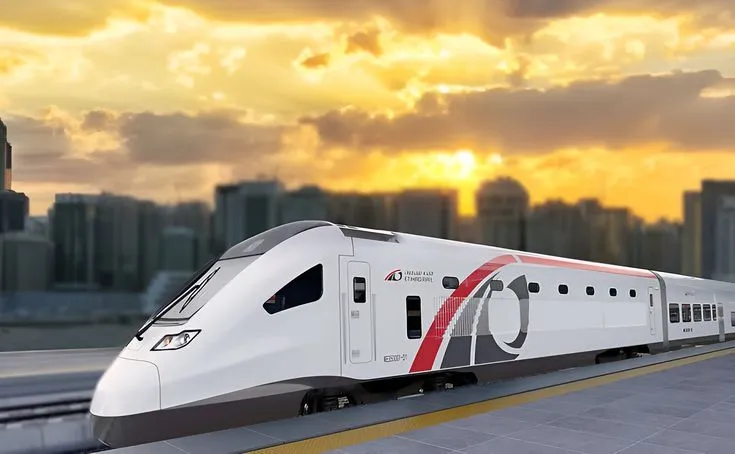
Etihad Rail Is Now Running! How it Could Reshape the UAE Real Estate Map
Etihad Rail's passenger services entered an introductory operational phase on 30 June 2026, with bookable scheduled journeys between Mohamed bin Zayed City in Abu Dhabi and Fujairah. The wider network officially expanded on 30 September with the opening of Dubai's Al Yalayis Station and Al Dhaid Station, while additional stations are scheduled to open in phases through March 2027.
By 3 August, Etihad Rail had reported more than 70,000 tickets sold, with demand from families, commuters, school groups, leisure travellers and visitors.
As the network expands, its implications extend beyond transport and into how people live, work and assess property across the UAE.
What Is the UAE Passenger Rail Network?
Etihad Rail's national network extends approximately 900 kilometres, connecting cities, ports, industrial centres and economic hubs from Ghuwaifat to Fujairah. Freight operations are already active, while passenger services are being introduced progressively.
The passenger network is expected to connect 11 cities and regions, with trains designed to travel at speeds of up to 200 kilometres per hour. Passenger services also include features such as guaranteed seating, onboard Wi-Fi, charging points and luggage space, while connections with buses, taxis and other modes of transport are being developed around the network.
When Do the Passenger Stations Open?
The passenger rollout is phased, so the status of each station matters when assessing a location.
- Operating: Mohamed bin Zayed City, Abu Dhabi, and Al Hilal City, Fujairah
- Scheduled for 30 September 2026: Jumeirah Golf Estates, Dubai, and Al Dhaid
- Scheduled from 30 December 2026: Al Dhafra stations, including Madinat Zayed, Al Dhannah, Al Mirfa and Liwa
- Scheduled from 30 March 2027: University City, Sharjah
These timelines should be checked against the latest official Etihad Rail announcements before making a property decision.
How Could Rail Change Where People Live?
One of the more interesting implications of passenger rail is that it could gradually widen the range of locations people consider practical.
A professional working in one emirate may have more residential choices if inter-emirate travel becomes predictable. Families may find it easier to remain connected across emirates. Students may have more accessible routes to education, while leisure travellers may find destinations that previously required longer road journeys easier to reach.
The potential effect is therefore not simply about property being “near a station”.
Which UAE Locations Could Be Affected by Etihad Rail?
The important distinction here is between a station location and its wider catchment. Not every nearby community has a direct station, and the practical benefit will depend on how easily residents can reach it.
- Mohamed bin Zayed City, Abu Dhabi
Mohamed bin Zayed City is home to Abu Dhabi's passenger station and forms part of the operating Abu Dhabi–Fujairah service.
Its wider catchment includes established residential and employment areas such as Mussafah, Shakhbout City and Bani Yas.
For real estate, the relevance is less about the station in isolation and more about whether improved inter-emirate connectivity strengthens the relationship between residential communities and employment centres.
- Jumeirah Golf Estates, Dubai
Dubai's passenger station is located in Jumeirah Golf Estates.
Its significance extends beyond the community itself because of its potential connections into Dubai's wider transport network. The broader catchment includes areas such as Al Furjan, Dubai Investments Park, Dubai Production City and Expo City.
Here, the practical question becomes particularly important: how easily can a resident actually get from their property to the station?
A property being on the same map as a station does not automatically make it a connected property.
- University City and Muwaileh, Sharjah
The planned University City station will serve an important education corridor in Sharjah.
For surrounding residential areas, the potential benefit may come from improving access to universities and inter-emirate travel.
However, existing liveability should remain the starting point. Rail should be considered an additional connectivity factor rather than the entire investment thesis.
- Al Hilal City, Fujairah
Al Hilal City is among the locations included in the initial passenger network.
For Fujairah, passenger rail introduces another connection to Abu Dhabi and the wider UAE, potentially changing how residents, visitors and businesses think about travel beyond the emirate.
- Al Dhaid and the Northern Emirates
Al Dhaid represents a different type of opportunity.
Rather than an established urban centre such as Dubai or Abu Dhabi, the station connects an inland location that has historically relied more heavily on road travel.
The broader question for investors is whether improved connectivity can support existing demand, future development and economic activity rather than assuming connectivity itself will create demand.
- Al Dhafra
The planned Al Dhafra stations include Madinat Zayed, Al Dhannah, Al Mirfa, Liwa and Al Sila.
These locations have very different economic and residential profiles, so they should not be treated as one property market.
For investors, local employment, existing housing demand, tourism, infrastructure and future development matter alongside rail connectivity.
Near a Station Is Not the Same as Well Connected
A property does not become well connected simply because there is a railway station nearby.
For a resident, the journey does not begin at the railway station. It begins at home. They may need to drive, take a taxi, use a bus or connect through another mode of transport before they even board the train. The same applies at the other end of the journey. So, when assessing a property, it is worth looking beyond the map.
Does Proximity to Etihad Rail Increase Property Value?
Not automatically. Major transport infrastructure can influence accessibility and may affect property demand, but the scale and direction of that effect vary by location, supply and market conditions.
A station announcement does not guarantee:
- Higher rental yield
- Immediate capital growth
- Strong resale liquidity
- High occupancy
- Successful community delivery
Property performance still depends on the wider fundamentals: actual accessibility, supply, tenant and end-user demand, community quality, construction standards, developer reputation, ownership costs and broader market conditions.
Beyond Homes: Where Else Could Rail Matter?
The real estate implications of Etihad Rail extend beyond residential property.
The national network connects economic hubs, ports and industrial centres, while freight operations are already active.
That creates a wider lens for investors and developers.
- Commercial property may need to be assessed in relation to employment centres and transport access.
- Hospitality and serviced residences may become relevant around destinations where visitor mobility improves.
- Industrial and logistics assets need to be considered alongside freight connectivity, zoning, tenant requirements and the location of economic activity.
- Development land can also warrant attention where infrastructure changes the long-term accessibility of a larger site.
The investment question therefore becomes broader than residential demand.
What Should Investors Assess?
Before treating Etihad Rail as part of an investment case, consider:
1. Station status
Is the station operating, scheduled, or still part of a longer-term network plan?
2. Actual door-to-door journey
Look beyond train time. Measure the complete journey from the property to the station and from the arrival station to the final destination.
3. Existing local demand
Who would actually use the property, and is rail relevant to their daily or regular routines?
4. Community fundamentals
Consider schools, healthcare, retail, amenities, green space, infrastructure and community management.
5. Future supply
Improved connectivity does not remove competition. A location can become more accessible while simultaneously receiving significant new property supply.
6. Developer and asset quality
Infrastructure cannot compensate for weak construction, poor planning or an unsuitable asset.
7. Ownership economics
Rental income, service charges, financing costs, maintenance and other ownership expenses still matter.
8. Time horizon
Infrastructure-led changes usually play out over time. An investor should distinguish between an established location receiving better connectivity and an emerging location that still needs demand and supporting infrastructure to develop.
How Etihad Rail is Forming Another Layer of Abu Dhabi's Growth Story
Etihad Rail may change how the market views certain locations, but connectivity alone is not an investment thesis.
The opportunity lies in assessing what that connectivity means for a specific asset; its accessibility, potential users, local demand and pricing, while looking beyond standard listings where privately introduced opportunities may also form part of the search.
For investors, the value is not simply in finding a property near the railway, but in understanding how improved connectivity fits into the wider growth and fundamentals of Abu Dhabi's property market.